
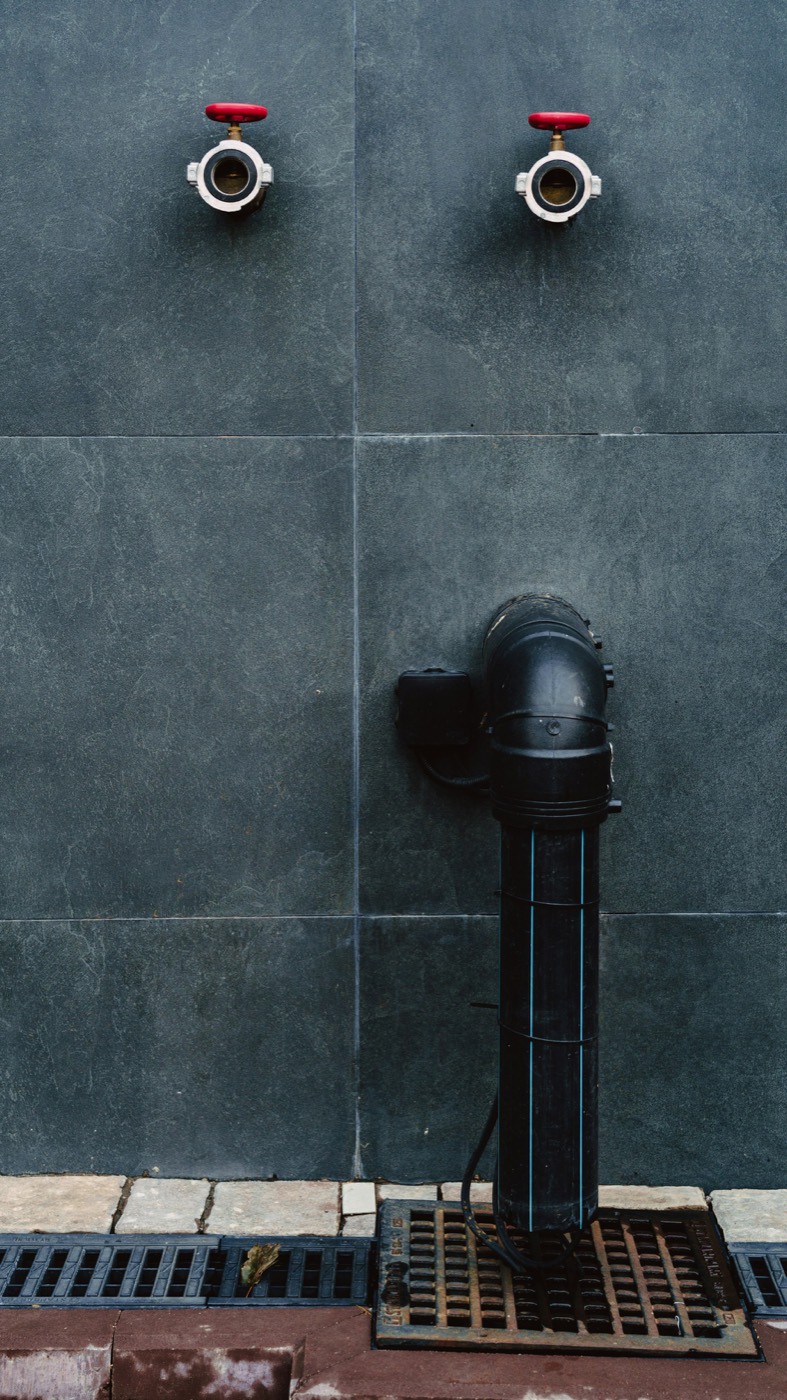
Standpipe Systems
The fire department’s water main runs inside your building.
In a multi-story or large-footprint building, standpipes are how firefighters get water to the fire floor without dragging hose up a stairwell. Class I, II, and III systems all live or die the same way: valves, piping, and connections that must hold pressure and flow on demand after years of sitting idle.
We inspect standpipe systems annually and run the 5-year flow and hydrostatic tests NFPA 25 requires, proving the hose valves open, the piping holds, and the most hydraulically remote outlet still gets its rated pressure.
What we do
- Annual visual and operational inspections per NFPA 25
- 5-year flow tests at the hydraulically most remote outlet
- 5-year hydrostatic testing of manual and dry standpipes
- Hose valve, cap, and pressure-reducing valve service
- Pump and FDC testing coordinated for whole-system verification
The required cycle
| Interval | What happens |
|---|---|
| Annual | Inspection of valves, connections, piping, and signage |
| 5-Year | Flow test and hydrostatic test per NFPA 25 |
What inspections typically find
The most common standpipe deficiencies in commercial buildings — each one gets a priority tier and a clear correction path on your report.
- Hose valves seized or leaking after years without operation
- Missing caps and damaged threads at floor outlets
- Pressure-reducing valves out of adjustment — dangerous in both directions
- Dry standpipes that fail hydrostatic testing from unnoticed corrosion
Why it matters
High-rise fire operations are built entirely around working standpipes. For owners, the 5-year test cycle is also a common gap that shows up in due diligence and insurance reviews of larger properties.
Standpipes questions, answered
What testing does a standpipe system need?
NFPA 25 calls for annual inspection of every standpipe component plus a 5-year cycle: a flow test proving the system delivers required pressure at the most remote outlet, and hydrostatic testing for dry and manual systems. High-rises usually pair this with fire pump flow testing.
Do standpipe requirements apply to buildings that aren’t high-rises?
Yes. Standpipes show up in large single-story buildings, parking structures, stadiums, and anywhere fire department access is limited, not just towers. If your building has hose valves in stairwells or at exits, it has a standpipe system with NFPA 25 obligations.
Put standpipes on a schedule that defends itself.
One assessment, one calendar, documentation your insurer and fire inspector can actually read.
714-465-8801We respond within one business day — emergencies, immediately.